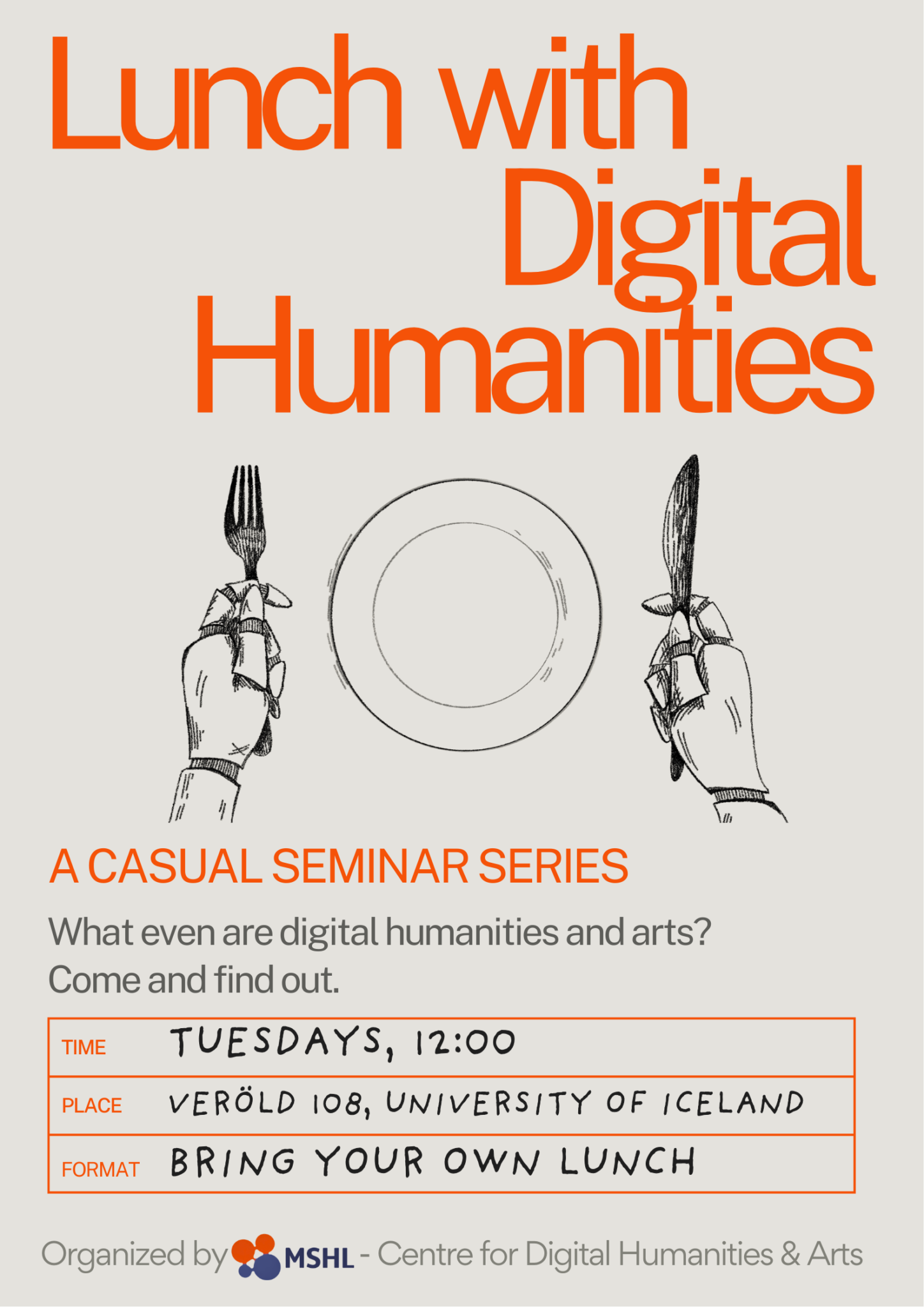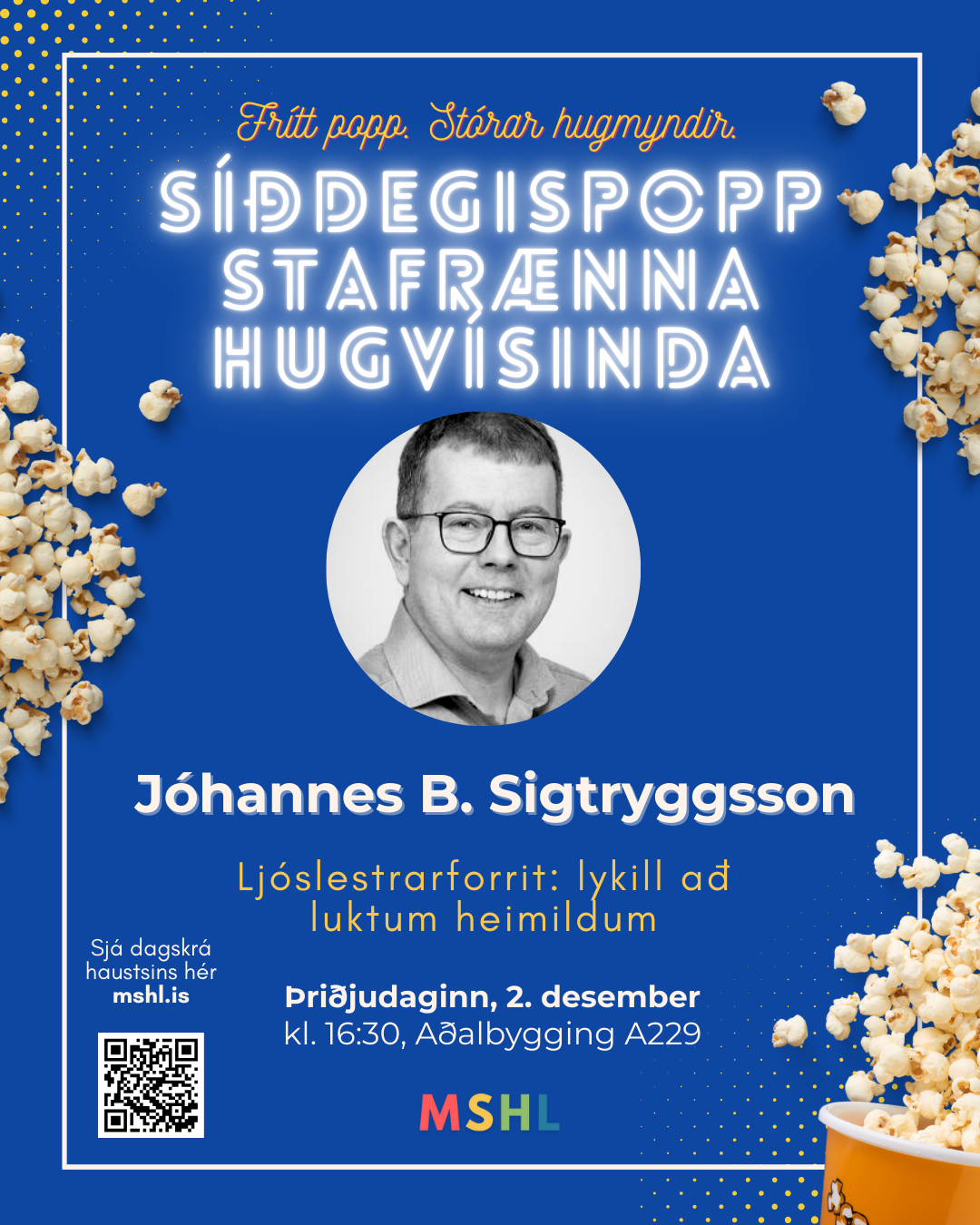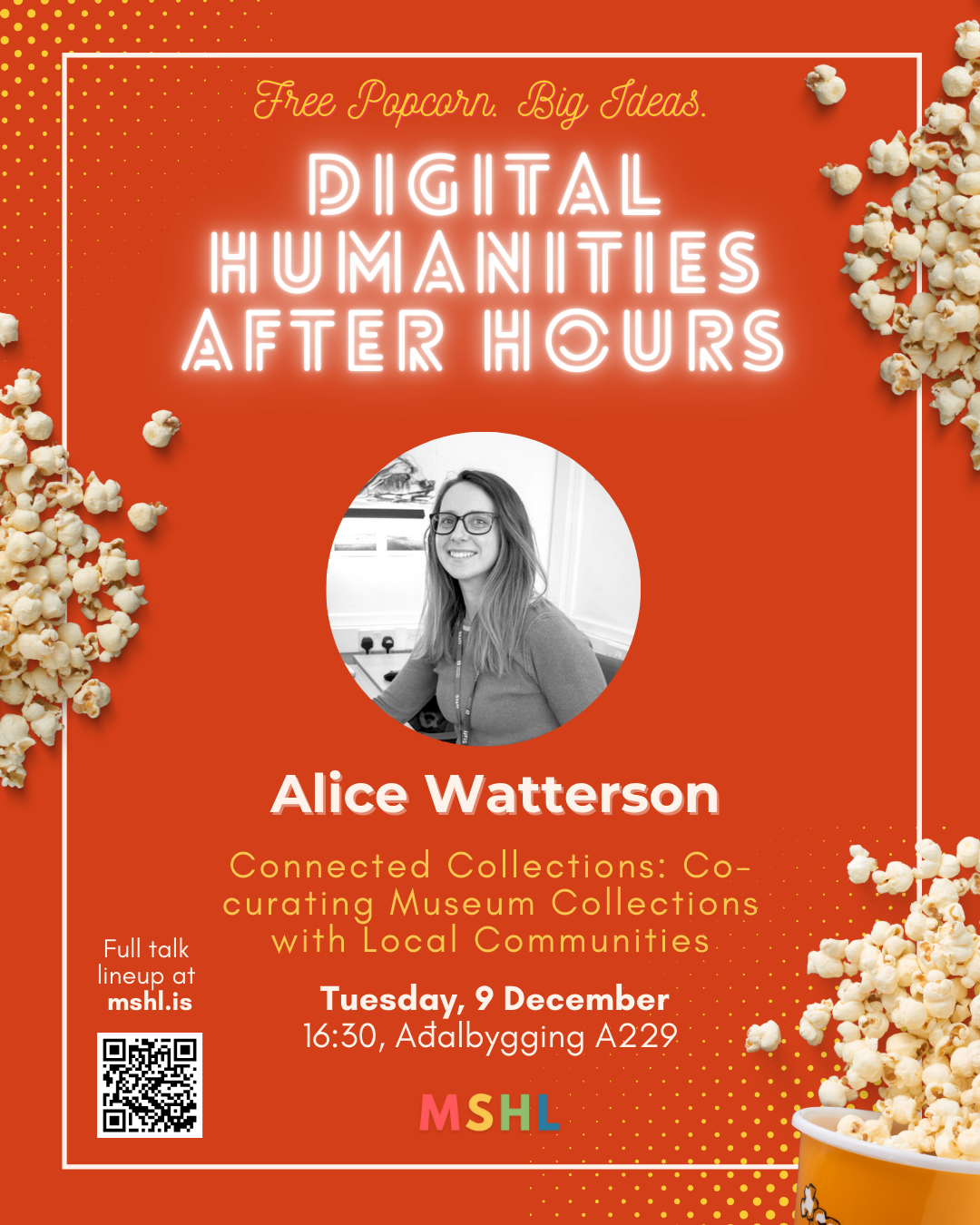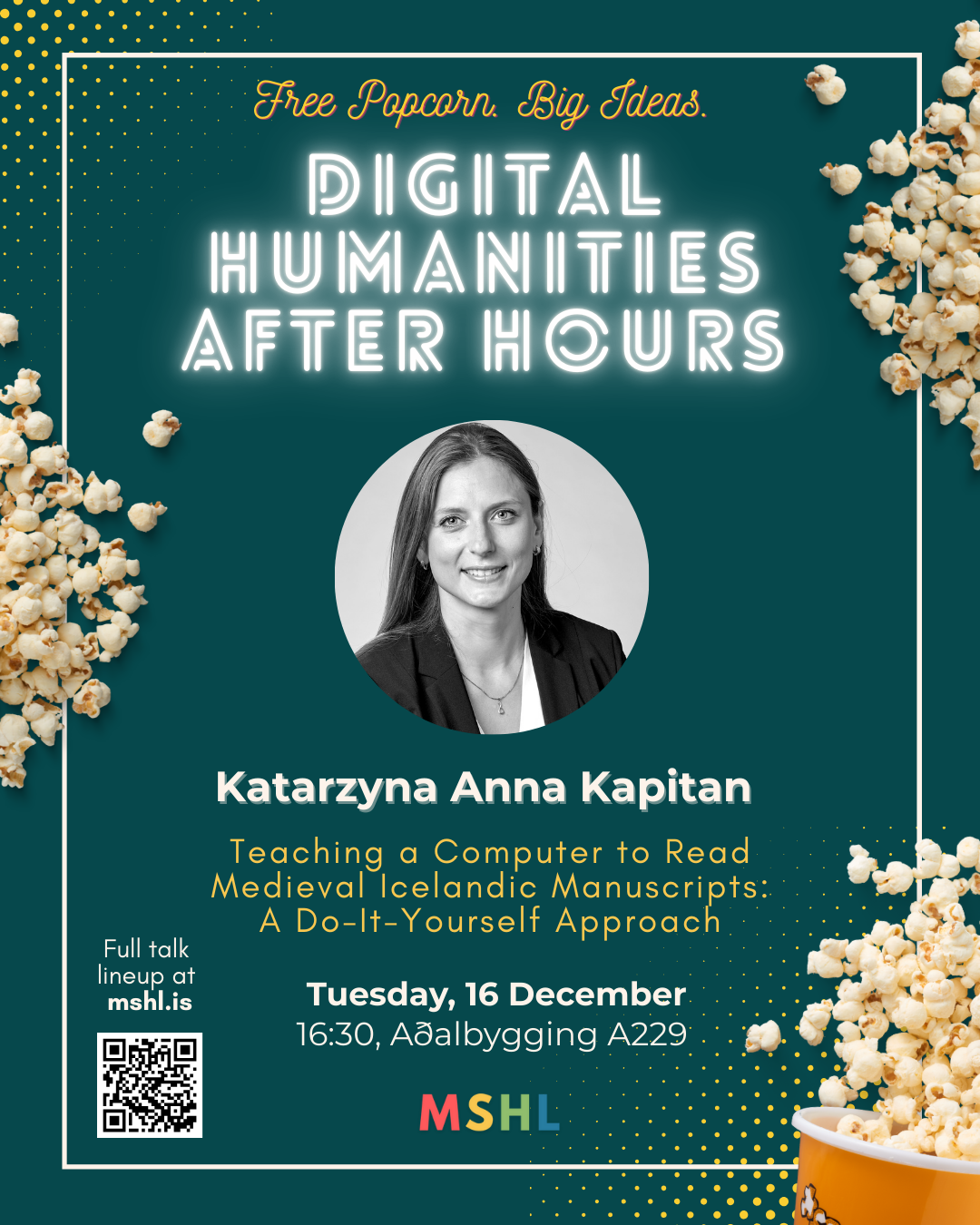
The Centre for Digital Humanities and Arts in Iceland is pleased to announce the continuation of its hybrid lecture series, Lunch with Digital Humanities, in Autumn 2026.
When: Tuesdays, 12:00 GMT
Where: University of Iceland, Oddi 206 and live on YouTube
This series brings together a range of experts working across digital humanities and the arts, offering informal, engaging talks designed for a broad audience. The focus is on sharing ideas and perspectives in a clear and accessible way, making the field approachable to anyone with an interest, no prior knowledge required.
The recordings are available on MSHL’s YouTube channel.
You can find the recordings and materials from our prior lecture series: Digital Humanities After Hours here and the Spring 2025 series of Lunch with Digital Humanities here.
A preliminary schedule can be found below. More information coming soon.
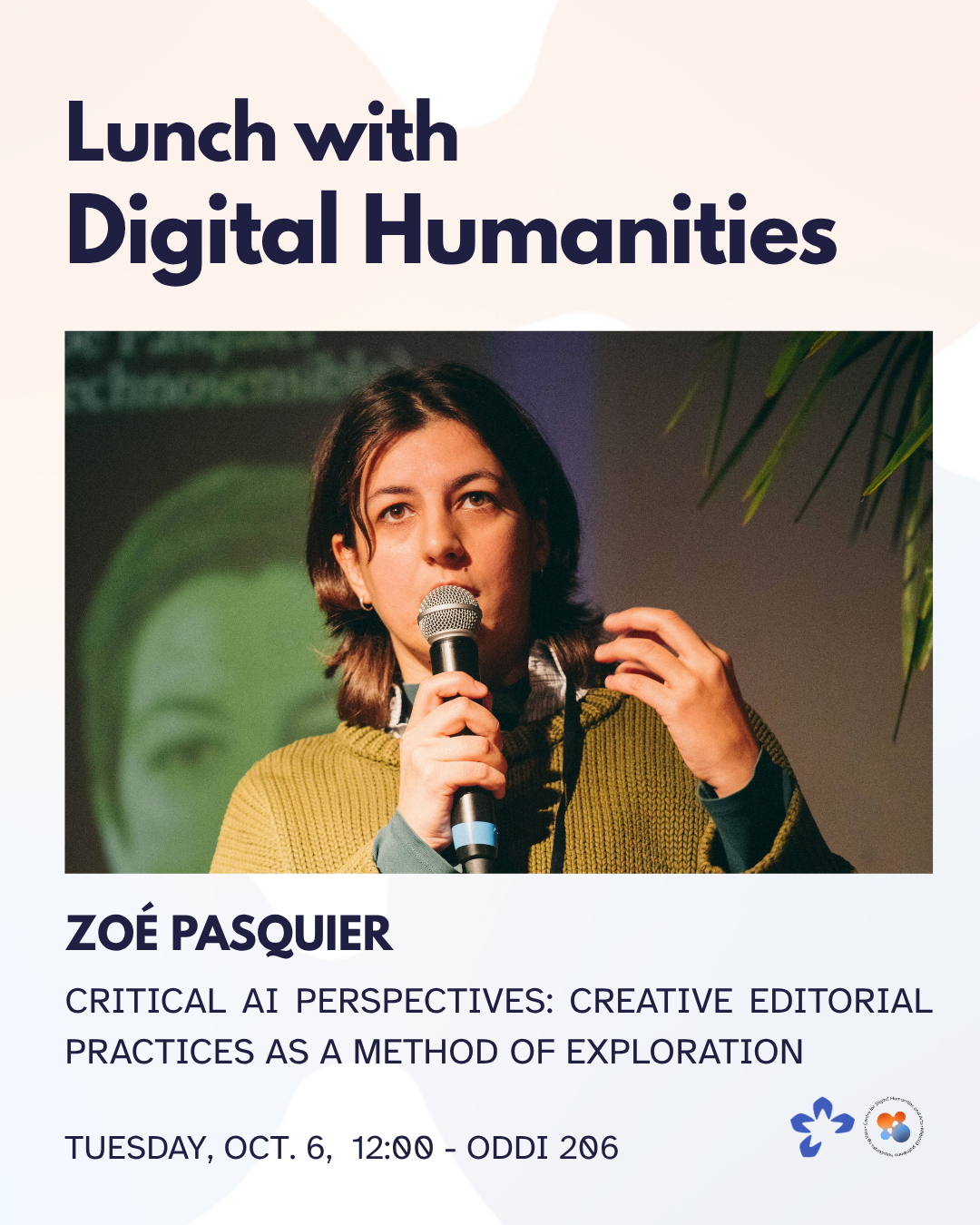
Zoé Pasquier, Université Paris Cité / Tours
Critical AI Perspectives: Creative Editorial Practices as a Method of Exploration
The talk is available here.
Over the past few years, Zoé Pasquier has developed a body of experimental media work exploring generative and AI-assisted editorial production, from a Solar TV project to an experimental technology media at La Gaîté Lyrique in Paris. This trajectory is now becoming a PhD (Université Paris Cité / Tours) on aesthetics in the age of AI-generated media. It traces that path as a series of editorial experiments, asking how creative practice can develop a critical, hands-on relationship to generative tools, treating them as material to interrogate.
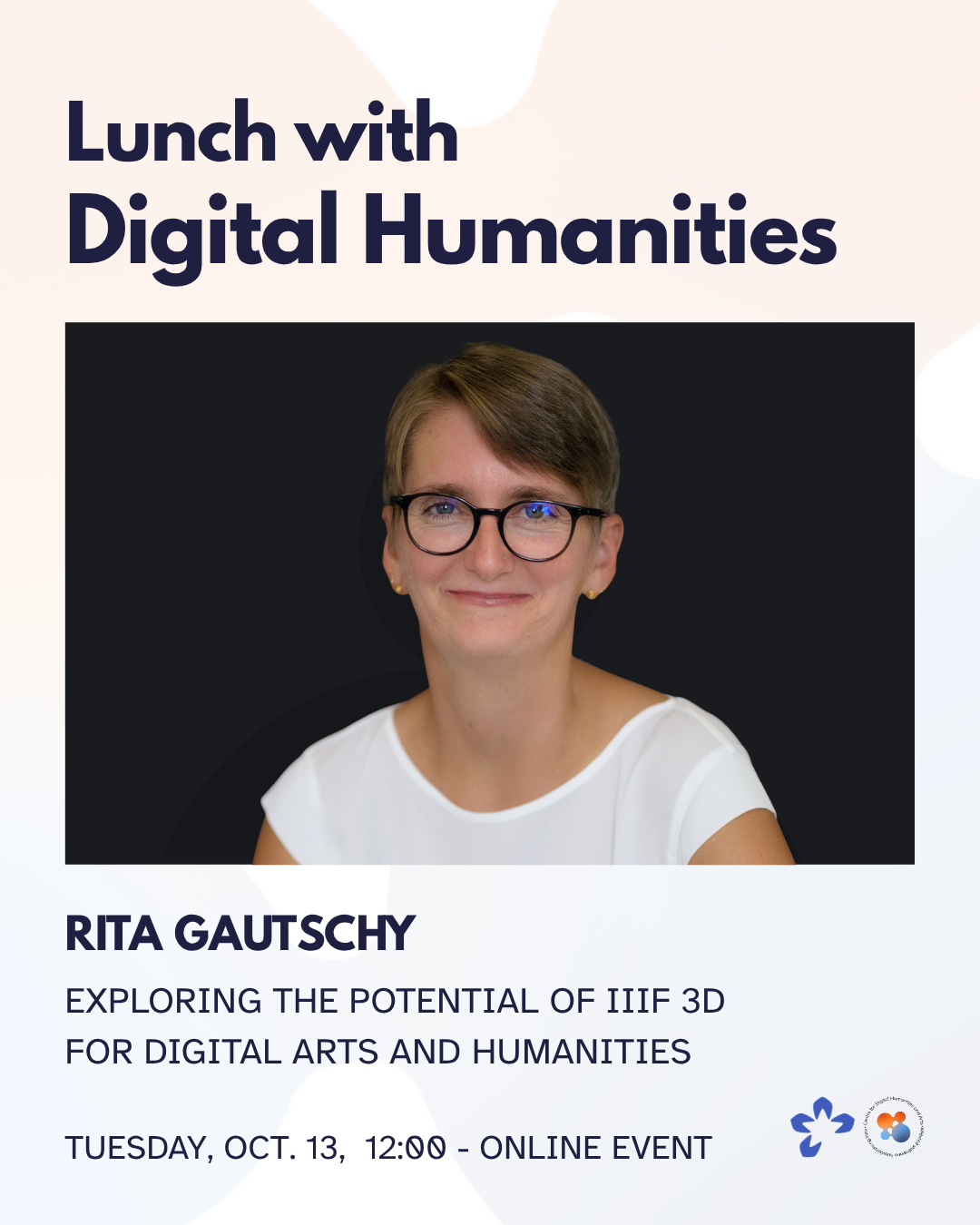
Rita Gautschy, DaSCH / University of Basel
Exploring the Potential of IIIF 3D for Digital Arts and Humanities
The talk is available here.
This lunch talk explores the emerging potential of IIIF (International Image Interoperability Framework) 3D for digital arts, humanities, and cultural heritage. Building on ongoing work within the IIIF 3D Technical Specification Group, it introduces how IIIF can bring the interoperability familiar from images and audiovisual resources to three-dimensional objects. Through practical examples, the talk will show how 3D models can be described, delivered, viewed, and connected with images, metadata, and other resources using open standards. It will also present current viewers, tools, experimental services and thoughts on how to preserve 3D data long-term.
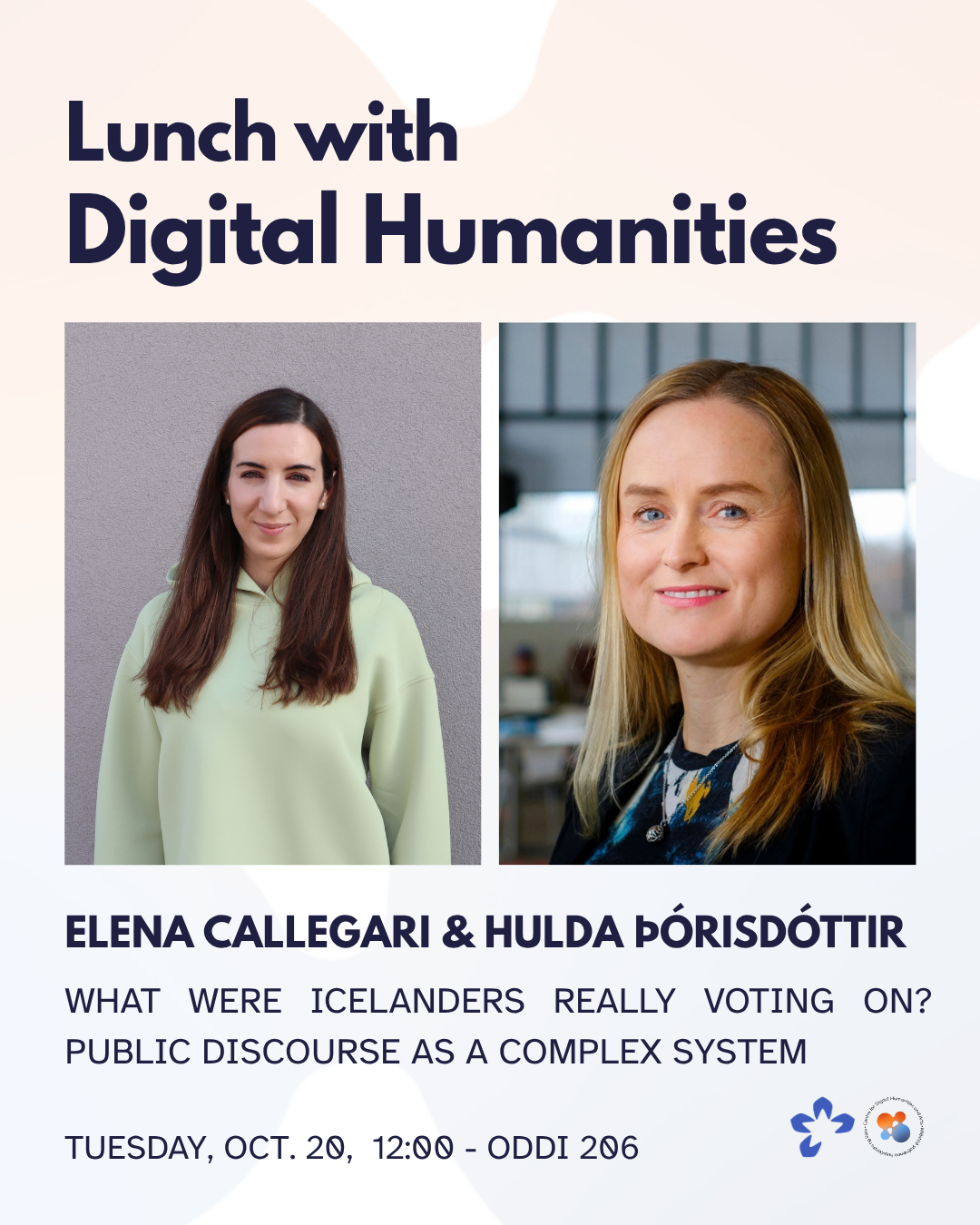
Elena Callegari, University of Iceland/Centre for Digital Humanities and Arts, and Hulda Þórisdóttir, University of Iceland
What Were Icelanders Really Voting On? Public Discourse as a Complex System
The talk is available here.
How does a public debate become polarized? Not through one speech, one headline, or one misleading claim, but through hundreds of small acts of repetition, reframing, omission and response.
This talk approaches public discourse as a complex system: a network in which local interactions can produce large-scale patterns that no single actor controls. Meanings shift as messages travel. Some frames become self-reinforcing; others disappear. Over time, different groups may no longer simply disagree about the answer: they may be responding to different versions of the question.
The recent Icelandic EU referendum provides a striking case. Why did ideas of independence and sovereignty gain such traction, while other seemingly plausible frames, such as security, barely surfaced? How did competing interpretations of what the referendum itself meant become established?
The talk asks what complexity science can add to the study of language, media and political communication, and what it might reveal about how public realities are built.
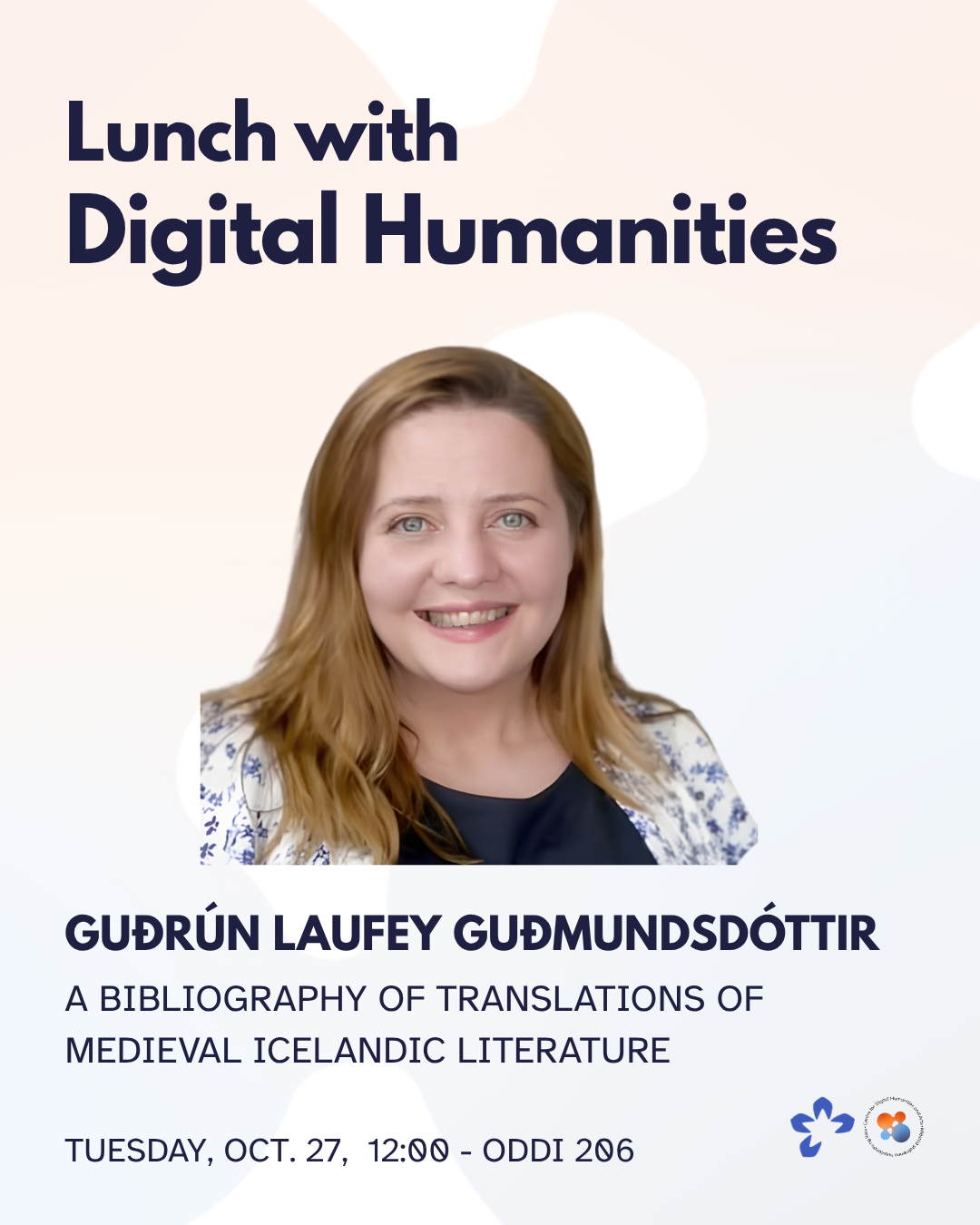
Guðrún Laufey Guðmundsdóttir, Landsbókasafn Íslands – Háskólabókasafn
A Bibliography of Translations of Medieval Icelandic Literature
The talk is available here.
The aim of the database, sagas.landsbokasafn.is, hosted by Landsbókasafn Íslands – Háskólabókasafn, is to keep track of translations of Old-Icelandic literature; Eddic poetry, sagas of Icelanders, þáttum, kings’ sagas, bishops’ sagas, contemporary sagas, legendary sagas, and romances. All in all 418 sagas. Information about the translations was sought far and wide, for instance in bibliographical works, databases, in libraries in Reykjavík, Copenhagen, and elsewhere, as well as from scholars around the world. More than 1.200 translators are now registered in the database, which contains information on ca. 2.000 books and around 10.000 references to translated sagas. The oldest being a Danish translation of Heimskringla dating from 1594 and the most recent an English translation of Hávamál, published earlier this year. The bibliography is a work in progress. New translations are continuously added to the database and the corresponding books are added to the library‘s collections for researchers and visitors.
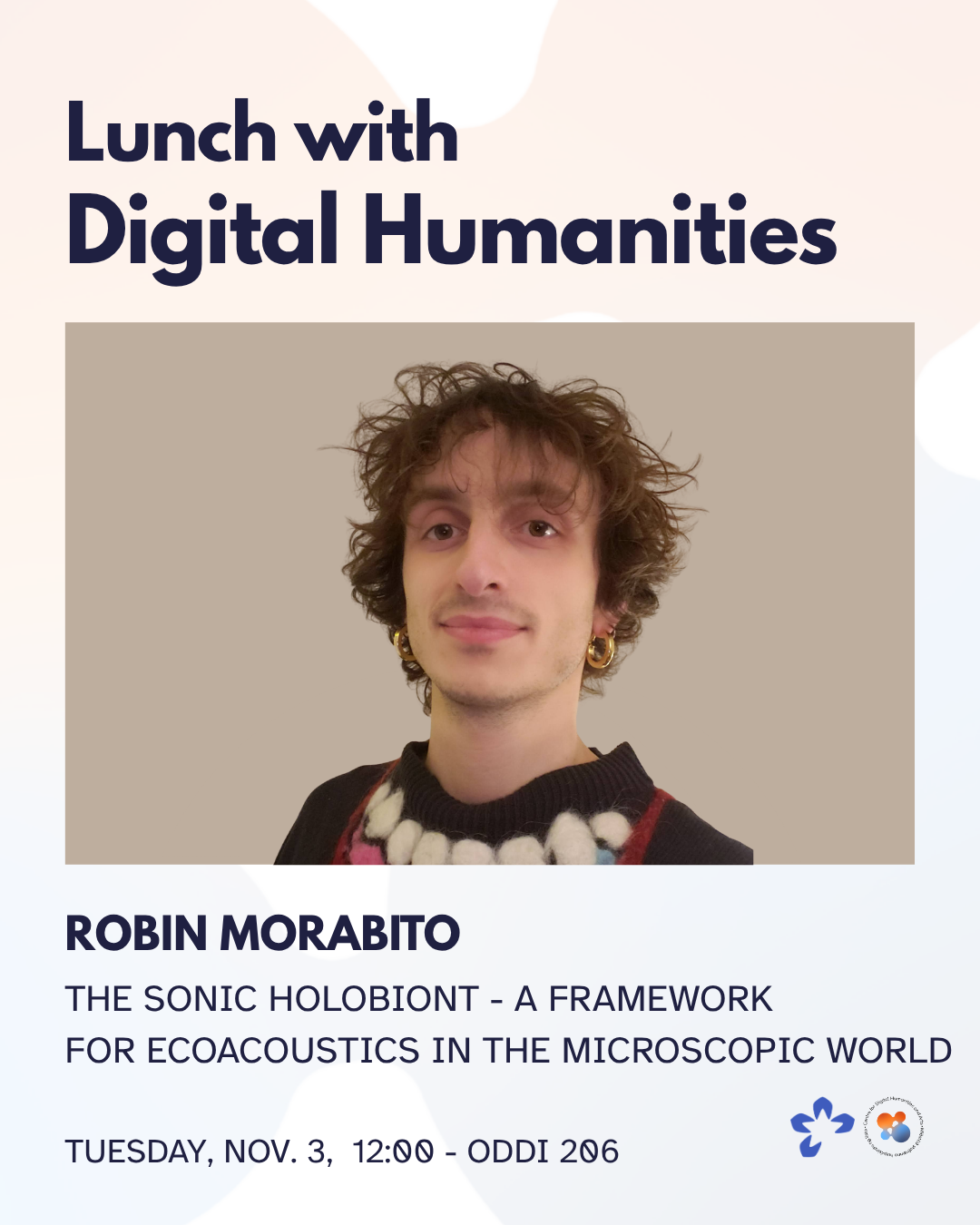
Robin Morabito, Iceland University of the Arts
The Sonic Holobiont – A Framework for Ecoacoustics in the Microscopic World
The talk is available here.
The sonic holobiont is the sum of all possible sonic relationships and influences within a defined soundscape, from micro- to macro-scale. It offers a framework for the sonic complexity of the biosphere, and it asks what sound might be at the scale of a single cell: how would it feel to a cell membrane, with no auditory encoding or decoding? Robin Morabito (LHÍ-MA Composition) presents the paper, co-written with researchers from Tor Vergata University in Rome, that first proposed the sonic holobiont as a viable framework for the intrinsic complexity of soundscapes in ecoacoustic studies.
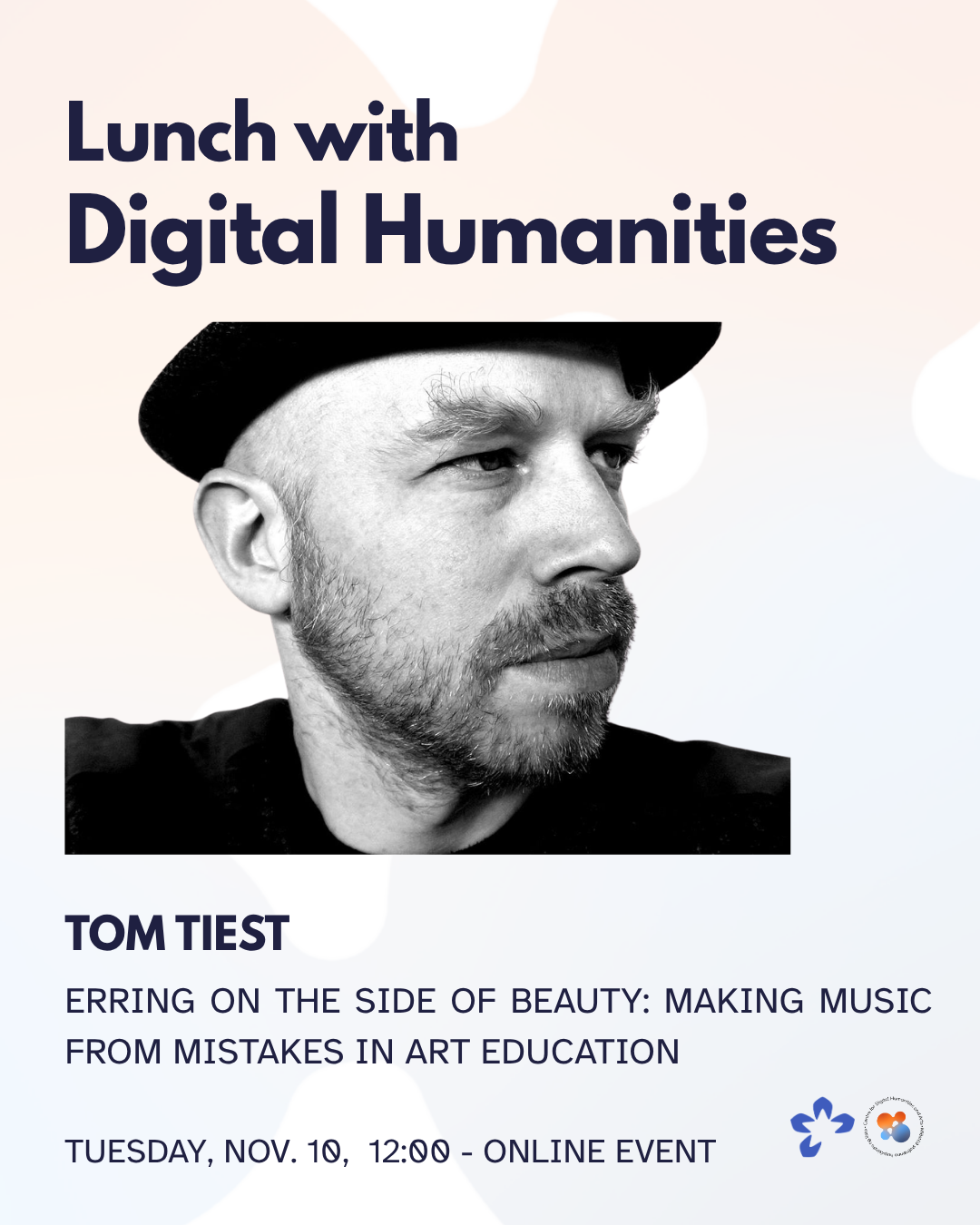
Tom Tiest, PXL-Music, PXL-University of Applied Sciences and Arts
Erring on the Side of Beauty : Making Music from Mistakes in Art Education
The talk is available here.
This research explores how Large Language Models (LLMs) and generative artificial intelligence (GenAI) tools can be employed as pedagogical and creative partners within education.
Central to the investigation is a re-evaluation of so‑called “errors,” which are not approached as mistakes to be corrected, but as inspiring or meaningful learning moments emerging from contingency, instability, and unpredictability. Rather than aiming for flawless musical results, the research prioritises process-oriented work, experimentation, and reflection as core values of musical learning.
The project followed a clearly delineated experimental learning trajectory. In its initial phase, commercial online ‘Text-to-Music Generators’ such as AIVA, Suno, and Udio were explored within an educational context. While these tools seemed to offer sonic and stylistic consistency, they ultimately, because of multiple factors discussed later on, proved less suitable for in‑depth, learning‑oriented use. Apart from AIVA, their largely ‘closed systems’ in free versions provide limited insight into underlying processes and offer little room for intervention, adaptation, or structural experimentation. Moreover, their strong emphasis on optimised end products leaves little space for deviation, serendipity, and discovery, all of which are essential components of educational learning processes.
As an alternative, the research shifted towards general-purpose LLMs capable of generating and modifying HTML files and the Web Audio API. This transition enabled a more open and flexible learning environment, in which pupils and students could actively construct, analyse, alter, and reconfigure musical systems. Within this context, LLMs functioned not as automatic producers of finished compositions but as co-designers in the creation of browser-based instruments, sequencers, and experimental digital learning environments comparable to simplified DAW-like interfaces.
Importantly, creativity within this educational framework extended beyond prompt formulation. Once these digital instruments and tools had emerged, learners could then engage creatively with their instruments. Their musical learning practices were shaped by the limitations and unexpected behaviours of the AI‑generated systems. Music-making thus became an exploratory dialogue between human intention, musical imagination, and machine-generated outcomes.
Over an extended period of experimentation involving multiple AI platforms, the research emphasises a continuous negotiation between the path offered by the generative AI and the users’ openness. In this new context, AI is neither positioned as an authority nor as a neutral tool, but as a fallible conversational partner within the learning process
Thomas Pausz, University of Iceland
Anda Baklāne, National Library of Latvia
Alice Heeley, University of Iceland
Cassidy Croci, University of Tübingen